Introduction
When the Human Genome Project was completed in 2003, it revolutionized biology by providing the first complete reference sequence of the human genome. Today, sequencing technologies have advanced so dramatically that laboratories can generate hundreds or even thousands of complete genomes in a single study. From tracking viral outbreaks and studying microbial diversity to investigating cancer evolution, modern biology has become a data-intensive science.
While generating genomic data has become increasingly affordable, analyzing these vast datasets remains a major computational challenge. For decades, researchers have relied on sequence alignment—the process of matching DNA, RNA, or protein sequences letter by letter—to compare genomes. Alignment has proven to be one of the cornerstones of bioinformatics, enabling scientists to identify mutations, conserved regions, and evolutionary relationships.
However, traditional alignment methods were designed during an era when datasets were much smaller than they are today. As sequencing technologies continue to produce data at unprecedented scales, researchers have begun exploring alternative computational strategies that can analyze genomes more efficiently.
One of the most promising directions is alignment-free genomics, a collection of methods that compare biological sequences without explicitly aligning every nucleotide or amino acid. Instead of focusing on exact positional matches, these methods analyze statistical, mathematical, and machine learning representations of sequences to uncover biological similarities.
Understanding Traditional Sequence Alignment
Imagine comparing two paragraphs to determine how similar they are. One approach is to compare every word in order, accounting for insertions, deletions, and substitutions until the best match is found. This is essentially how sequence alignment works for biological sequences.
Algorithms such as Needleman-Wunsch, Smith-Waterman, and BLAST search for optimal alignments between DNA or protein sequences. These methods have become indispensable in molecular biology because they allow researchers to:
- Identify homologous genes between species
- Detect mutations and genetic variants
- Study evolutionary relationships
- Annotate newly sequenced genomes
- Compare proteins with known functions
For many applications, alignment remains the gold standard. However, its computational cost increases substantially as datasets become larger. Aligning tens of thousands of long genomes may require significant computing resources and processing time.
What Does "Alignment-Free" Mean?
Alignment-free genomics takes a fundamentally different approach. Rather than trying to determine the optimal nucleotide-by-nucleotide correspondence between sequences, it converts biological sequences into mathematical representations that can be compared directly.
Instead of asking:
"Where exactly do these sequences align?"
alignment-free methods ask questions such as:
- Do these genomes exhibit similar sequence composition?
- Do they contain comparable short DNA patterns?
- Can machine learning recognize hidden biological similarities?
- Can statistical signatures reveal evolutionary relationships?
This shift dramatically reduces computational complexity while opening opportunities for artificial intelligence to participate in biological analysis.
The Core Ideas Behind Alignment-Free Analysis
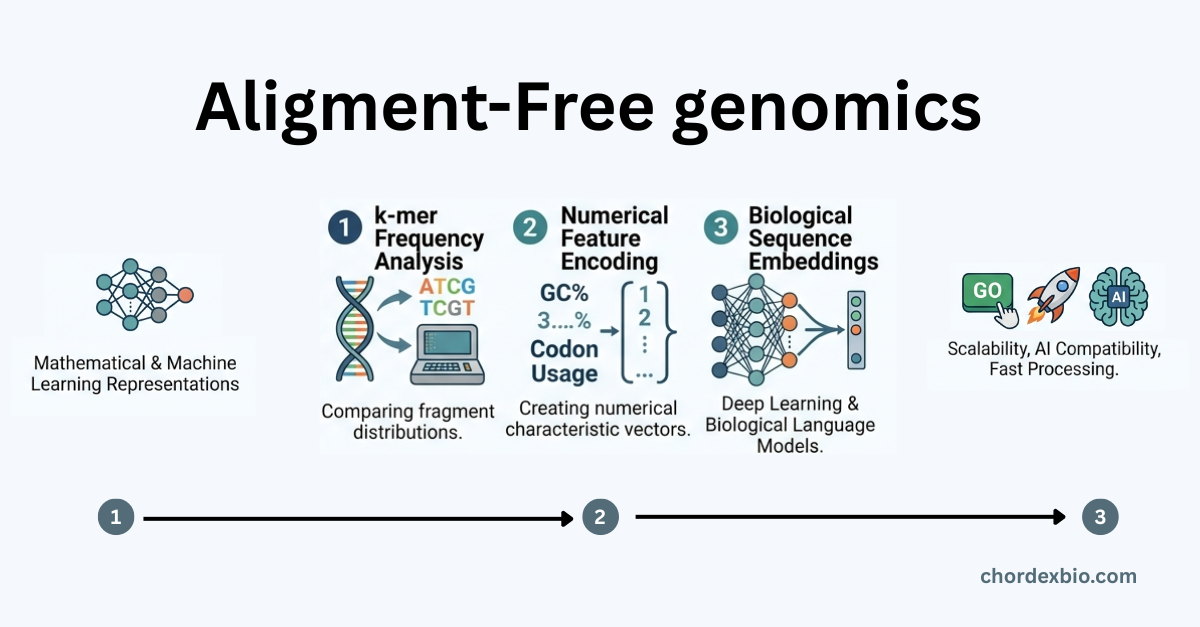
1. k-mer Analysis
Perhaps the most common alignment-free technique involves breaking DNA sequences into short fragments called k-mers. If k equals 4, then every four-letter DNA segment becomes one observation.
For example, the DNA sequence:
ATCGTACG
contains the following 4-mers:
ATCG
TCGT
CGTA
GTAC
TACG
Rather than comparing every nucleotide individually, researchers compare the frequency of these fragments across genomes. Similar organisms often display similar k-mer distributions.
2. Numerical Feature Encoding
Sequences can also be transformed into numerical vectors representing biological characteristics such as nucleotide composition, codon usage, GC content, entropy, or other engineered features. These vectors allow conventional machine learning algorithms to analyze genomic data in the same way they analyze tabular datasets.
3. Sequence Embeddings
Recent advances in deep learning have introduced biological embeddings, where neural networks learn compact numerical representations of DNA or protein sequences. Much like language models learn relationships between words, biological embedding models learn relationships between sequences, often capturing functional or evolutionary information without requiring explicit alignment.
Why Researchers Are Interested in Alignment-Free Methods
Alignment-free approaches provide several practical advantages:
- Faster analysis of large genomic collections.
- Reduced computational requirements.
- Compatibility with machine learning workflows.
- Scalability to thousands or millions of sequences.
- Flexible integration with statistical and AI models.
These properties make them particularly useful in applications such as pathogen surveillance, metagenomics, biodiversity studies, comparative genomics, and large-scale phylogenetics.
Artificial Intelligence Meets Genomics
One reason alignment-free genomics has gained significant attention is its compatibility with artificial intelligence. Machine learning models require numerical inputs, and alignment-free representations naturally provide those inputs.
Instead of relying solely on manually engineered biological features, modern AI systems can learn representations directly from genomic sequences. These learned representations often capture subtle biological relationships that may be difficult to observe using traditional approaches alone.
Researchers are increasingly exploring transformer architectures, graph neural networks, representation learning, and self-supervised learning for biological sequence analysis. These techniques continue to reshape computational genomics and expand the range of questions that can be investigated computationally.
Does This Mean Alignment Is No Longer Needed?
Absolutely not.
Alignment-free genomics should not be viewed as a replacement for traditional bioinformatics. Instead, the two approaches complement one another.
A common workflow may involve using alignment-free methods to rapidly screen thousands of genomes and identify clusters or interesting candidates. Researchers can then perform detailed alignment-based analyses on those selected sequences to investigate mutations, structural variations, or conserved regions.
Choosing the appropriate method depends on the scientific question being asked rather than assuming one approach is universally superior.
Real-World Applications
Alignment-free methods are already being explored across numerous research areas:
- Tracking emerging viral variants during outbreaks.
- Characterizing microbial communities through metagenomics.
- Comparing bacterial genomes across large surveillance studies.
- Rapidly screening genomic databases for related organisms.
- Supporting AI-driven phylogenomic research.
As sequencing continues to accelerate, these approaches are expected to become increasingly valuable in both research and clinical settings.
How ChordexBio Builds on These Concepts
At ChordexBio, our research explores how artificial intelligence can complement traditional computational biology. Projects such as Covary investigate translation-aware, alignment-free representations designed to support scalable phylogenomics and genomic intelligence. Rather than replacing established bioinformatics workflows, these approaches seek to provide additional computational tools for analyzing increasingly complex biological datasets.
As AI continues to evolve, we believe that combining biological expertise with machine learning will help researchers analyze genomic information more efficiently while uncovering patterns that may otherwise remain hidden.
Key Takeaways
- Alignment-free genomics compares biological sequences without explicit sequence alignment.
- These methods often transform sequences into mathematical or machine learning representations.
- They are particularly useful for large-scale genomic analysis where traditional alignment becomes computationally expensive.
- Artificial intelligence is accelerating the development of alignment-free techniques.
- Alignment-free and alignment-based methods work best when used together, depending on the biological question.
Continue Learning
Learn more about our innovation in genomic representations using TIPs-VF (Translator-Interpreter Pre-seeding for Variable-length Fragments):
Learn more about our innovation in whole-genome intelligence using Covary:
Hi, I’m Dexter 😎 I handle resource management at ChordexBio—building tutorials, guides, and technical content that actually make sense. I like breaking down complex ideas into clear, usable write-ups, whether it’s for onboarding, research workflows, or product documentation.
