Introduction
If you've spent any time reading bioinformatics papers, you've almost certainly encountered the term k-mer. Although it sounds like specialized jargon, k-mers are actually one of the simplest—and most powerful—ideas in computational biology.
From genome assembly and sequence comparison to metagenomics and artificial intelligence, k-mers appear in countless algorithms because they provide a practical way to transform biological sequences into numerical information that computers can analyze efficiently.
In this guide, we'll explore what k-mers are, why they matter, how they are generated, and how modern computational biology uses them to understand genomes at massive scale.
What Is a k-mer?
A k-mer is simply a sequence of k consecutive nucleotides extracted from a longer DNA sequence.
The value of k determines the fragment length.
- k = 3 → every fragment contains 3 nucleotides
- k = 5 → every fragment contains 5 nucleotides
- k = 21 → every fragment contains 21 nucleotides
Suppose we have the following DNA sequence:
ATCGTACGA
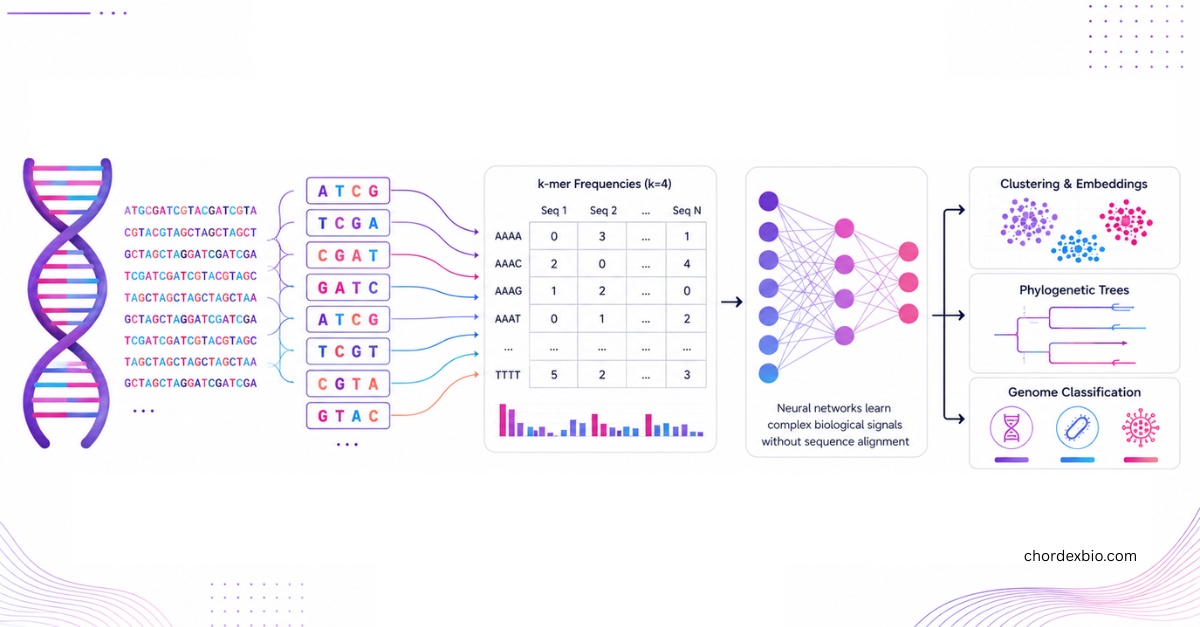
If we choose k = 4, the sequence becomes:
ATCG
TCGT
CGTA
GTAC
TACG
ACGA
Instead of viewing the genome as one long string, we now have a collection of overlapping fragments that preserve much of its local structure.
Why Do We Break DNA Into Small Pieces?
Computers struggle to interpret biological sequences directly. While humans recognize DNA as a meaningful biological language, computers initially see only long strings of characters.
Breaking genomes into k-mers provides several advantages:
- Transforms DNA into measurable units.
- Allows statistical analysis.
- Enables rapid sequence comparison.
- Produces numerical features for machine learning.
- Scales well to millions of sequences.
Think of it like analyzing a book. Instead of comparing every sentence word by word, you might compare the frequency of common phrases. Those phrase frequencies often reveal writing style, topic, or authorship. k-mers play a similar role for genomes.
Counting k-mers
Most algorithms don't simply list k-mers—they count how often each one appears.
For example:
Genome A

ATCG = 42
CGTA = 31
GTAC = 27
TACG = 18
These counts become numerical features describing the genome.
Closely related organisms frequently exhibit similar k-mer frequency distributions, making them useful for measuring similarity without performing traditional sequence alignment.
Choosing the Right Value of k
Selecting an appropriate k is one of the most important design decisions in any k-mer algorithm.
Small k values
Small k values (such as 3 or 4) produce fewer unique fragments and require less computation. However, they often fail to distinguish between closely related genomes because many organisms share common short DNA patterns.
Large k values
Larger values produce much richer representations but dramatically increase the number of possible combinations.
Because DNA contains four nucleotides (A, C, G, and T), the total number of possible k-mers equals:
4k
This grows extremely quickly:
| k | Possible k-mers |
|---|---|
| 2 | 16 |
| 4 | 256 |
| 6 | 4,096 |
| 8 | 65,536 |
| 10 | 1,048,576 |
| 15 | 1,073,741,824 |
As k increases, computational requirements grow rapidly. Researchers therefore choose k based on the biological question and available computing resources.
How k-mers Are Used in Bioinformatics
Genome Assembly
Many genome assembly algorithms reconstruct complete genomes by identifying overlaps between k-mers extracted from sequencing reads.
Metagenomics
Environmental samples often contain DNA from thousands of organisms. k-mer signatures help classify species without assembling complete genomes.
Sequence Search
Large genomic databases can be searched efficiently using k-mer indexing instead of comparing every nucleotide individually.
Variant Detection
Unexpected k-mer frequencies may indicate mutations, sequencing errors, or structural variations.
Phylogenomics
Comparing k-mer profiles provides a fast approximation of evolutionary relationships among organisms.
k-mers and Artificial Intelligence
Artificial intelligence models require numerical inputs. Raw DNA sequences cannot be processed directly by most machine learning algorithms.
One solution is to transform genomes into vectors using k-mer frequencies. Each unique k-mer becomes a feature, and its count becomes a numerical value.
This creates a mathematical representation suitable for clustering, classification, dimensionality reduction, or deep learning.
Although newer representation learning approaches continue to evolve, k-mers remain one of the most widely used foundations for computational genomics because they are intuitive, efficient, and biologically meaningful.
Advantages of k-mer Methods
- Simple to understand.
- Easy to compute.
- Highly scalable.
- Compatible with machine learning.
- Useful across diverse biological applications.
- Can be applied without sequence alignment.
Limitations
Despite their strengths, k-mers are not perfect.
- They ignore long-range relationships within DNA.
- Choosing the wrong value of k can reduce performance.
- Large k values require significant memory.
- Frequency alone may miss important biological context.
Modern AI methods increasingly combine k-mers with richer sequence representations, embeddings, and deep learning models to capture more complex biological information.
How ChordexBio Builds Beyond k-mers
k-mers have been one of the foundational ideas in computational genomics for decades, but they are only one way to represent biological sequences. At ChordexBio, our research investigates richer sequence representations that preserve biological information while supporting scalable machine learning. Projects such as TIPs explore translation-aware representations, while Covary applies advanced sequence encoding strategies for alignment-free phylogenomics and genomic intelligence. These approaches build upon the strengths of traditional methods while exploring new ways for AI to understand biological sequences.
Key Takeaways
- A k-mer is a DNA fragment of length k.
- k-mers transform genomes into machine-readable features.
- They are widely used in genome assembly, metagenomics, phylogenomics, and machine learning.
- The choice of k directly affects accuracy and computational cost.
- Many modern AI methods build upon or extend the principles introduced by k-mer analysis.
What's Next?
Now that you understand how genomes can be represented using k-mers, the next step is learning how these numerical representations become inputs for artificial intelligence. In our next resource, we'll explore genome embeddings and how modern machine learning models learn biological patterns directly from DNA sequences.
Hi, I’m Dexter 😎 I handle resource management at ChordexBio—building tutorials, guides, and technical content that actually make sense. I like breaking down complex ideas into clear, usable write-ups, whether it’s for onboarding, research workflows, or product documentation.
