ChordexBio is pleased to announce that Bea Nicole S. Gacayan, a ChordexBio Program Partner who graduated from De La Salle University, has had her research abstract accepted for the 2026 scientific meeting of the Philippine Society for Cell Biology (PSCB). Co-authored with Marvin De los Santos of ChordexBio, the study explores how machine learning-based genomic analysis can help researchers investigate cross-species molecular variation relevant to tissue engineering.
Titled “From Code to Fold: Rapid Multi-Species Molecular Compatibility Screening of Angiogenesis-Associated Genes Using Omics-Based Artificial Intelligence for Tissue Engineering,” the study demonstrates an application of Covary, ChordexBio’s translation-aware genomic embedding framework, to the comparative analysis of angiogenesis-associated genes across vertebrate species.
From vascular tissue to computational biology
Bea’s interest in angiogenesis began with her undergraduate thesis on vascular tissue decellularization. That experience prompted her to explore how blood vessels contribute to tissue repair and regeneration. Through ChordexBio, she found an opportunity to pursue these questions from a computational perspective, using genomic data to investigate molecular differences across species.
This transition from laboratory-based research to computational biology reflects an important opportunity in modern life sciences: biological questions can be investigated through complementary experimental and computational approaches. Rather than replacing laboratory work, genomic analysis can help researchers identify patterns and prioritize questions for further investigation.
Screening angiogenesis-associated genes across 22 vertebrate species
Angiogenesis—the formation of new blood vessels—is essential to tissue growth, repair, and regeneration. Understanding how angiogenesis-associated genes vary across species may help researchers investigate molecular similarities and differences relevant to tissue engineering and cross-species biomaterial research.
In this study, the researchers analyzed 1,860 coding sequences representing 86 angiogenesis-associated ortholog sets across 22 vertebrate species using Covary. They evaluated cross-species separation through principal component analysis (PCA), uniform manifold approximation and projection (UMAP), and t-distributed stochastic neighbor embedding (t-SNE), using composite percentile ranks to identify genes with notable separation patterns.
Three genes (PTK2, RBPJ, and VEGFA) showed upper-quartile separation and reproducible subclustering. These results provided a basis for more targeted investigation of the sequence-level differences underlying the observed patterns.
From genomic patterns to molecular differences
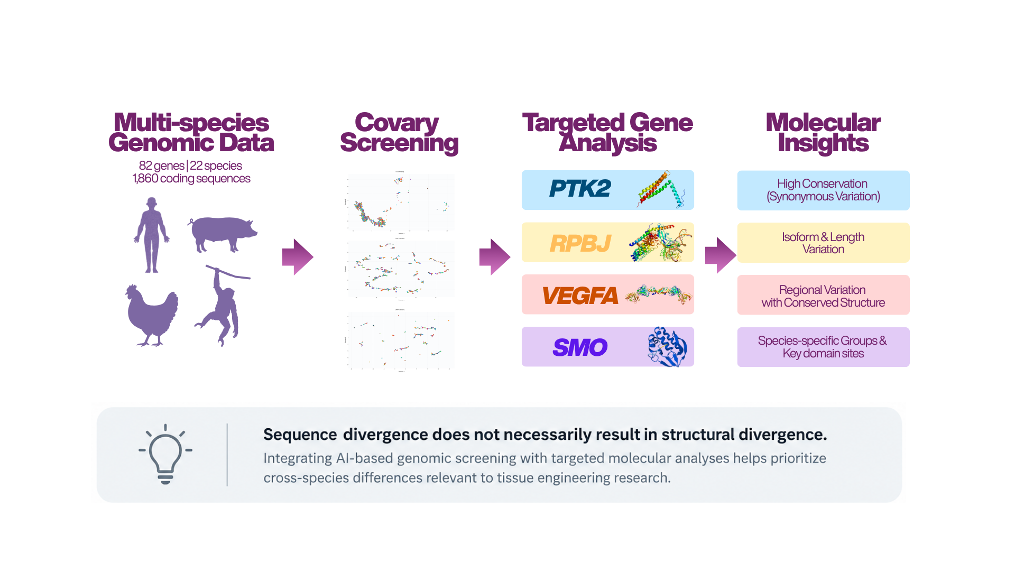
To examine these patterns more closely, the researchers conducted targeted analyses of 63 coding sequences and compared selected protein sequences and predicted structures.
- RBPJ: The analysis found 98.8% median amino-acid identity, with 91.1% of changed codons being synonymous.
- VEGFA: The gene showed 91.3% median amino-acid identity alongside substantial variation in protein length.
- PTK2: The gene showed 96.4% median amino-acid identity, with sequence variation extending into its FERM domain. AlphaFold2 comparisons showed 97.5% FERM sequence identity and a root-mean-square deviation (RMSD) of 0.171 Å between human and pig, compared with 76.4% identity and 0.684 Å RMSD between human and medaka.
The study also examined SMO, identifying a reproducible division of 22 species into groups of seven and fifteen. Of the 22 species assignments, 21 corresponded to taxonomic groupings. Further sequence analysis narrowed 79 group-associated positions to nine alignment-stable positions within the cysteine-rich domain. Across 25 AlphaFold3 predictions representing five species, the researchers observed no reproducible gross structural rearrangement beyond model-level variability.
Together, these analyses illustrate why genomic similarity requires careful interpretation. Similar embedding patterns can coexist with different forms of molecular variation, including synonymous substitutions, differences in protein-length architecture, and variation within particular protein regions. Computational screening can help identify these patterns, while targeted sequence and structural analyses provide additional context.
What this means for Covary and tissue engineering
Covary is a machine-learning framework developed by ChordexBio for large-scale biological sequence analysis. Its translation-aware, alignment-free embeddings provide an alternative approach to comparing genetic sequences without relying on conventional multiple sequence alignment.
Applying Covary to angiogenesis-associated genes extends its use beyond phylogenetic and genome-comparison studies into a research question relevant to tissue engineering. In this work, genomic embeddings served as an initial screening approach, followed by targeted sequence analysis and protein-structure comparisons to investigate the molecular differences behind selected patterns.
The findings do not, by themselves, establish functional equivalence between species or demonstrate that a particular cross-species material is suitable for tissue engineering. Instead, they support an integrated approach in which computational screening helps organize molecular comparisons and guide further investigation.
Expanding opportunities for Filipino researchers
Bea’s work illustrates the kind of independent, question-driven research that ChordexBio seeks to support through its Covary Research Program. By bringing machine learning into biological investigation, the program creates opportunities for researchers to explore computational methods while building on their existing scientific interests and training.
For Bea, this project connects her earlier laboratory experience with a growing interest in computational biology. For ChordexBio, it demonstrates how a Filipino-developed genomic intelligence framework can be applied to a research question spanning comparative genomics, protein structure, and tissue engineering.
As AI-driven methods become increasingly relevant to life science research, ChordexBio remains committed to developing computational tools and supporting researchers who use them to investigate meaningful biological questions.
About the researchers
Bea Nicole S. Gacayan is a ChordexBio Program Partner who graduated from De La Salle University, Manila. Her research interests include angiogenesis, tissue engineering, and computational biology. Her experience with vascular tissue decellularization informed her interest in exploring cross-species molecular variation using genomic data.
Marvin De los Santos is a project leader at ChordexBio, where he develops computational approaches for biological sequence analysis and genomic intelligence, including Covary.
Explore the work: Visit Covary to learn more about the genomic analysis framework, explore ChordexBio’s research programs, or browse its research outputs and publications.
Hi, I’m Dexter 😎 I handle resource management at ChordexBio—building tutorials, guides, and technical content that actually make sense. I like breaking down complex ideas into clear, usable write-ups, whether it’s for onboarding, research workflows, or product documentation.